Urban emergency response in India has come a long way. But step outside city limits into hilly districts, tribal areas, flood zones and the situation is completely different. Standard ambulance vans need proper roads. In a lot of rural India, those roads don’t exist.
A motorcycle ambulance gets around that problem. It goes where vans can’t and it gets there faster.
The Real Problem in Rural Healthcare and the Last Mile
India has over 6 lakh villages. Most don’t have a proper road to a hospital. Many don’t even have a basic health centre nearby. A medical emergency in these areas means waiting 45 minutes if you’re lucky, two hours or more if you’re not.
Getting treatment isn’t always the main problem. Getting to treatment in time that’s where people are actually dying.
A bike ambulance in India has been solving this for years. It’s not new and it’s not experimental. A motorbike ambulance pushes through flooded village paths, narrow mountain tracks, terrain that stops any van cold. Snakebite, trauma, cardiac events, complicated deliveries the minutes saved by a motorcycle ambulance can be the difference between life and death.
Understanding the Motorcycle Ambulance
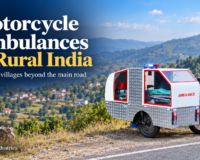
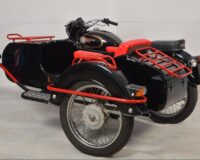
A motorbike ambulance is a modified motorcycle typically fitted with a sidecar or trailer attachment that carries first aid equipment, basic life support tools and in some configurations, a stretcher for patient transport.
It was never designed to replace a hospital. The purpose is rapid first response: stabilize the patient, provide initial care and safely move them to the nearest health facility. It is the critical first link in the emergency care chain.
Some configurations in India use sidecar-style attachments. Others use compact trailers capable of carrying a lying patient. Either way, the core advantage is the same speed and access where larger vehicles simply cannot go.
Why First Responder Bikes Work Better in Remote Regions
A rural area bike ambulance brings real operational advantages cost, speed, maneuverability and ease of deployment all work in its favou
Cost is a major factor. A standard ambulance van costs lakhs to procure, requires a licensed driver, fuel, insurance and ongoing maintenance. A First Responder Bike operates at a fraction of that making it a viable option for village-level health programs running on limited budgets. For many organizations, the choice is a bike ambulance or nothing at all.
Speed matters too. On decent roads, a motorcycle ambulance still beats a van weaving through traffic, squeezing past market crowds, cutting through narrow lanes. Every minute saved is a minute closer to care.
Maneuverability is another advantage that often goes unspoken. Mountain paths, flooded village tracks, crowded festival grounds a motorbike ambulance goes where vans cannot. Across India’s Northeast, parts of Chhattisgarh and remote Rajasthan districts, a bike ambulance is not a secondary option. It is the only practical one.
And deployment is relatively straightforward. Community health workers, including ASHAs and ANMs, can be trained to operate a medical motorcycle unit without requiring a commercial driving license or extended technical training.
Motorcycle Ambulance in India and Real-World Adoption and Impact
More organizations are using these than most people realize.
State health departments in Odisha, Assam, Jharkhand have already run motorbike ambulance programs maternal emergencies, accident response, remote area coverage. NGOs and international health bodies have done the same, particularly for snakebite cases in tribal belts where road infrastructure is practically nonexistent.
The 108 emergency service, operating across multiple Indian states, has acknowledged the limitations of van-based response in remote areas. Bike-based programs have been trialed as direct complements to the broader system, not as replacements but as essential first responders where the van cannot reach.
ARAI-authorized sidecar manufacturers in India have been central to making this possible producing motorcycle ambulance attachments that are affordable, field-tested, and compatible with widely available motorcycle models, so health programs can actually deploy and maintain them at scale.
Essential Medical Equipment in a Bike Ambulance
Standard kit on a motorbike ambulance includes trauma supplies bandages, tourniquets, wound care. Add to that a small oxygen cylinder, BP monitor, stethoscope, IV fluids, and anti-snake venom where the terrain calls for it. There’s usually a communication device too, so the responder stays in contact with the nearest facility.
Sidecar units go a step further spine board, patient stretcher, room to transport someone who can’t sit upright.
The goal was never to replace a hospital. Just keep the patient alive long enough to reach one.
The Role of Sidecars in First Responder Bikes
A common misconception is that a motorbike ambulance is simply a bike with a medical kit strapped to it. Sidecar configurations change the capability significantly.
A sidecar-equipped medical motorcycle can transport a lying patient an entirely different level of utility. This matters for trauma cases, unconscious patients, or women in active labour who cannot remain seated.
Purpose-built ambulance sidecars are engineered for weight distribution and patient stability, with easy-access loading and compatibility across common motorcycle models. When built to proper standards and ARAI authorization, the result is not a makeshift solution it is a genuine micro-ambulance designed for terrain where full-size vehicles cannot operate.
The sidecar approach gives rural health programs a deployable, affordable, and field-ready vehicle. That combination is difficult to achieve any other way.
Challenges in Deploying Bike Ambulances and How They Are Being Addressed
Bike ambulances in India face real operational challenges, and it is worth being direct about them.
Training remains an ongoing need. First responders must be equipped not just to ride, but to deliver initial medical care under pressure. State health programs and NGOs have been investing in community health worker training, and coverage is improving but gaps remain in the most remote districts.
Infrastructure is another factor. Even a motorcycle cannot navigate every terrain condition. Some areas still need road connectivity improvements alongside better vehicle solutions, and the two investments work best in parallel.
Awareness at the community level also lags behind. Many residents in remote areas are unaware that bike ambulance services exist or how to access them. Last-mile communication is as important as last-mile transport.
None of these challenges invalidate the model. They shape how it should be deployed with proper training frameworks, community integration, and ongoing support from local health systems. The core vehicle solution is sound.
The Future of First Responder Motorcycles and Where the Technology Is Heading
The motorcycle ambulance is not a static concept. The technology and programs around it are actively developing.
Electric bike ambulances are being explored in several programs quieter, lower in maintenance, and better suited for hilly terrain where managing fuel supply is logistically complex. Solar charging infrastructure at village health centres is being developed alongside these units.
GPS tracking and telemedicine integration are being added to some deployments, allowing a riding responder to consult with a doctor remotely while in transit to the patient. This effectively extends specialist care into areas that would otherwise have none.
Drone-delivered medical supplies are also being piloted as a complement to the rural area bike ambulance model enabling blood, medication, or critical supplies to be dropped at a location before the responder even arrives.
The motorcycle ambulance is not a stopgap measure. It is a developing platform with considerable room to grow.
Why Inder Auto Industries Stands Apart in This Space
Deploying a motorcycle ambulance in India whether for an NGO, a state health program, a CSR initiative, or an international development project depends heavily on the quality of the vehicle and its attachment. A poorly engineered sidecar in remote field conditions is not just ineffective; it is a liability.
Inder Auto Industries has been manufacturing sidecar and vehicle attachment solutions since 1989. The company holds ARAI authorization from the Government of India and has exported its products internationally. Their ambulance sidecar for motorcycles and scooters is built for real-world Indian field conditions engineered for weight distribution, patient stability, ease of loading, and compatibility with widely available motorcycle models.
This is not a large conglomerate producing medical vehicles as a side product. This is a focused manufacturer with over three decades of specialized experience in sidecar design, built around the specific demands of Indian roads and terrain. That depth of experience matters when the vehicle needs to perform reliably in conditions that would compromise lesser equipment.
For organizations serious about first responder bike deployment, that track record is worth more than any specification sheet.
Final Thought
A bike ambulance does not attract headlines the way a new hospital wing does. It is not a glamorous investment. But in a remote village, when someone needs emergency care and the nearest road is five kilometres of mud, a motorcycle ambulance arriving in time is the difference between life and death.
The solution exists. It is field-proven, increasingly sophisticated, and more accessible than ever. What it needs is broader deployment, sustained funding, and continued awareness.
For organizations looking to make a measurable impact on rural emergency healthcare access or for procurement teams evaluating first responder vehicle solutions visit Inder Auto Industries to learn more about what Inder Auto Industries offers and how their solutions can be deployed in the field.
FAQs
What is a Motorcycle Ambulance and How Is It Different from a Regular Ambulance?
A motorcycle ambulance is a motorcycle fitted with a sidecar or medical attachment carrying emergency supplies and sometimes a patient stretcher. Unlike a standard ambulance van, it is designed for speed and access in terrain where four-wheeled vehicles cannot operate effectively.
How Does a Bike Ambulance Operate in Remote Areas of India?
A trained first responder rides the medical motorcycle to the emergency site, provides initial stabilization and care, then transports the patient to the nearest health facility. In sidecar configurations, patients can be transported lying down, which is critical for trauma or unconscious cases.
Which Indian States Have Led the Way in Motorbike Ambulance Deployment?
States including Odisha, Assam, Jharkhand, Chhattisgarh, and several northeastern states have piloted or deployed bike ambulance programs, primarily for maternal health emergencies and accident response in remote tribal and hilly areas.
What Medical Equipment Does a Rural Area Bike Ambulance Carry?
Standard equipment includes trauma kits, bandages, portable oxygen, a blood pressure monitor, IV fluids, anti-snake venom where relevant, and a communication device. Sidecar configurations may also include spine boards or patient stretchers.