CategoriesMotorcycle Ambulance

Innovative First Responder Bike Solutions for Remote Regions

Urban emergency response in India has come a long way. But step outside city limits  into hilly districts, tribal areas, flood zones and the situation is completely different. Standard ambulance vans need proper roads. In a lot of rural India, those roads don’t exist.

A motorcycle ambulance gets around that problem. It goes where vans can’t and it gets there faster.

The Real Problem in Rural Healthcare and the Last Mile

India has over 6 lakh villages. Most don’t have a proper road to a hospital. Many don’t even have a basic health centre nearby. A medical emergency in these areas means waiting  45 minutes if you’re lucky, two hours or more if you’re not.

Getting treatment isn’t always the main problem. Getting to treatment in time  that’s where people are actually dying.

A bike ambulance in India has been solving this for years. It’s not new and it’s not experimental. A motorbike ambulance pushes through flooded village paths, narrow mountain tracks, terrain that stops any van cold. Snakebite, trauma, cardiac events, complicated deliveries  the minutes saved by a motorcycle ambulance can be the difference between life and death.

Understanding the Motorcycle Ambulance

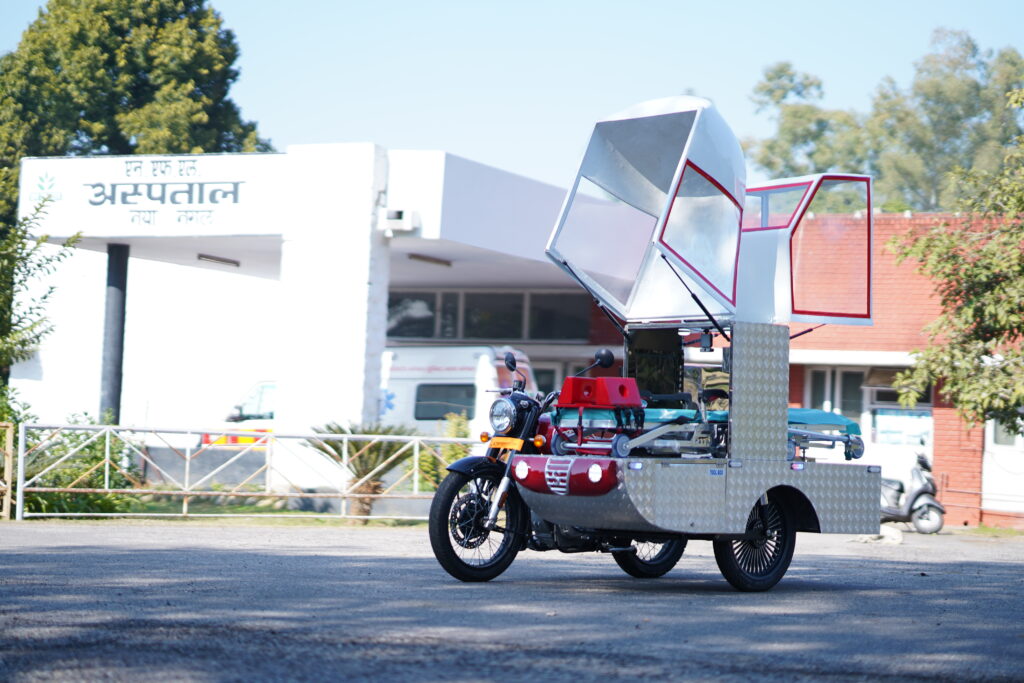
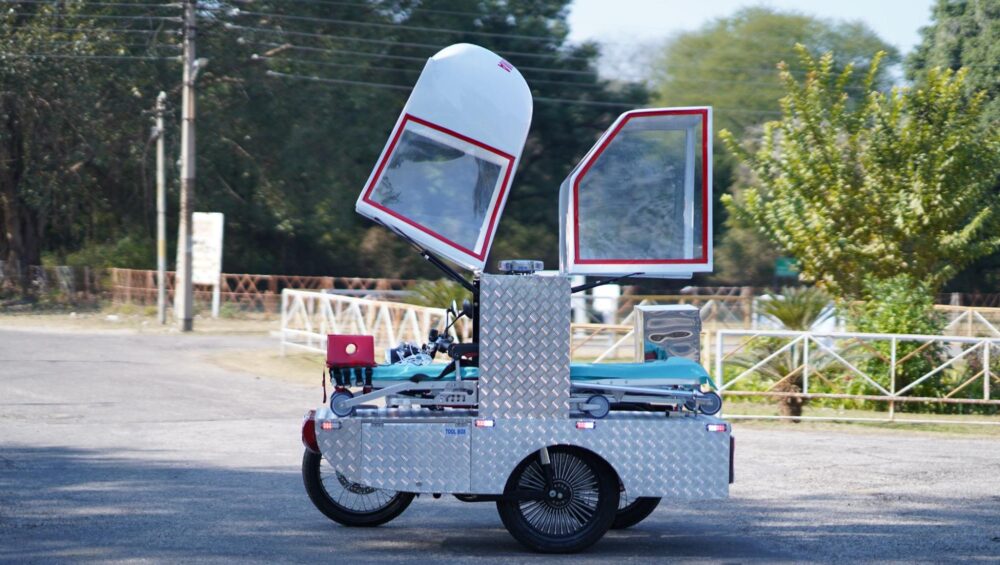
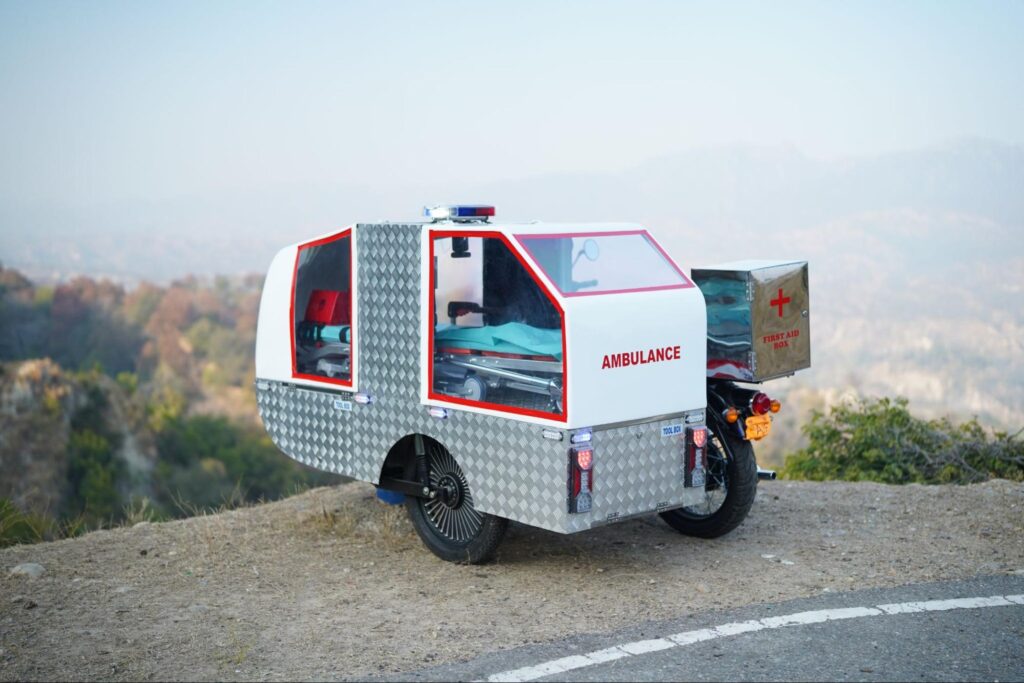
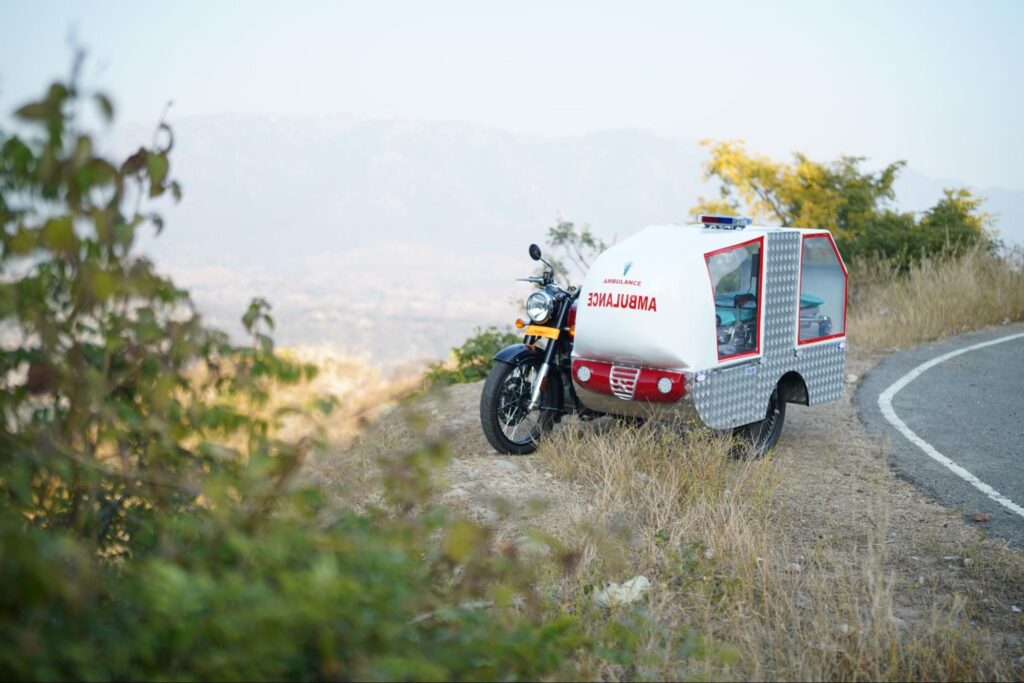
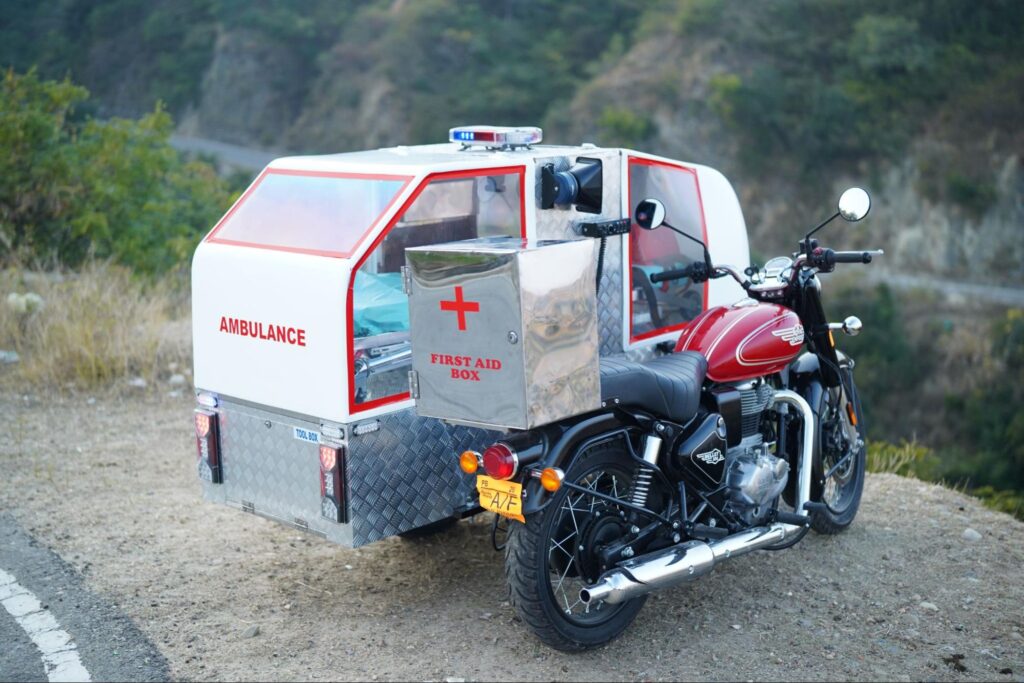
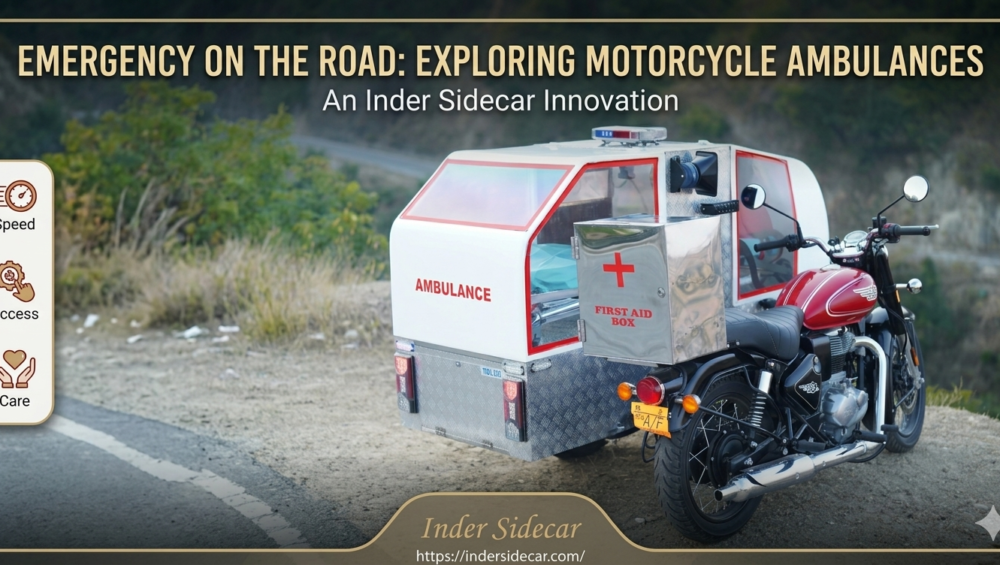
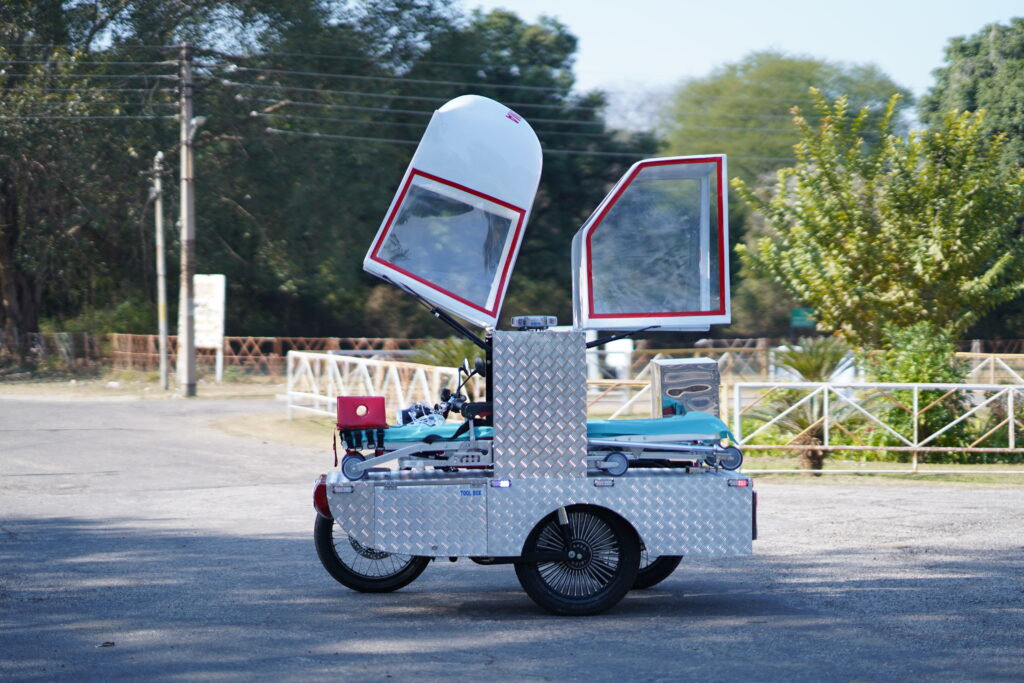
A motorbike ambulance is a modified motorcycle  typically fitted with a sidecar or trailer attachment  that carries first aid equipment, basic life support tools and in some configurations, a stretcher for patient transport.

It was never designed to replace a hospital. The purpose is rapid first response: stabilize the patient, provide initial care and safely move them to the nearest health facility. It is the critical first link in the emergency care chain.

Some configurations in India use sidecar-style attachments. Others use compact trailers capable of carrying a lying patient. Either way, the core advantage is the same  speed and access where larger vehicles simply cannot go.

Why First Responder Bikes Work Better in Remote Regions

A rural area bike ambulance brings real operational advantages  cost, speed, maneuverability and ease of deployment all work in its favou

Cost is a major factor. A standard ambulance van costs lakhs to procure, requires a licensed driver, fuel, insurance and ongoing maintenance. A First Responder Bike operates at a fraction of that making it a viable option for village-level health programs running on limited budgets. For many organizations, the choice is a bike ambulance or nothing at all.

Speed matters too. On decent roads, a motorcycle ambulance still beats a van  weaving through traffic, squeezing past market crowds, cutting through narrow lanes. Every minute saved is a minute closer to care.

Maneuverability is another advantage that often goes unspoken. Mountain paths, flooded village tracks, crowded festival grounds  a motorbike ambulance goes where vans cannot. Across India’s Northeast, parts of Chhattisgarh and remote Rajasthan districts, a bike ambulance is not a secondary option. It is the only practical one.

And deployment is relatively straightforward. Community health workers, including ASHAs and ANMs, can be trained to operate a medical motorcycle unit without requiring a commercial driving license or extended technical training.

Motorcycle Ambulance in India and Real-World Adoption and Impact

More organizations are using these than most people realize.

State health departments in Odisha, Assam, Jharkhand have already run motorbike ambulance programs  maternal emergencies, accident response, remote area coverage. NGOs and international health bodies have done the same, particularly for snakebite cases in tribal belts where road infrastructure is practically nonexistent.

The 108 emergency service, operating across multiple Indian states, has acknowledged the limitations of van-based response in remote areas. Bike-based programs have been trialed as direct complements to the broader system, not as replacements but as essential first responders where the van cannot reach.

ARAI-authorized sidecar manufacturers in India have been central to making this possible producing motorcycle ambulance attachments that are affordable, field-tested, and compatible with widely available motorcycle models, so health programs can actually deploy and maintain them at scale.

Essential Medical Equipment in a Bike Ambulance

Standard kit on a motorbike ambulance includes trauma supplies  bandages, tourniquets, wound care. Add to that a small oxygen cylinder, BP monitor, stethoscope, IV fluids, and anti-snake venom where the terrain calls for it. There’s usually a communication device too, so the responder stays in contact with the nearest facility.

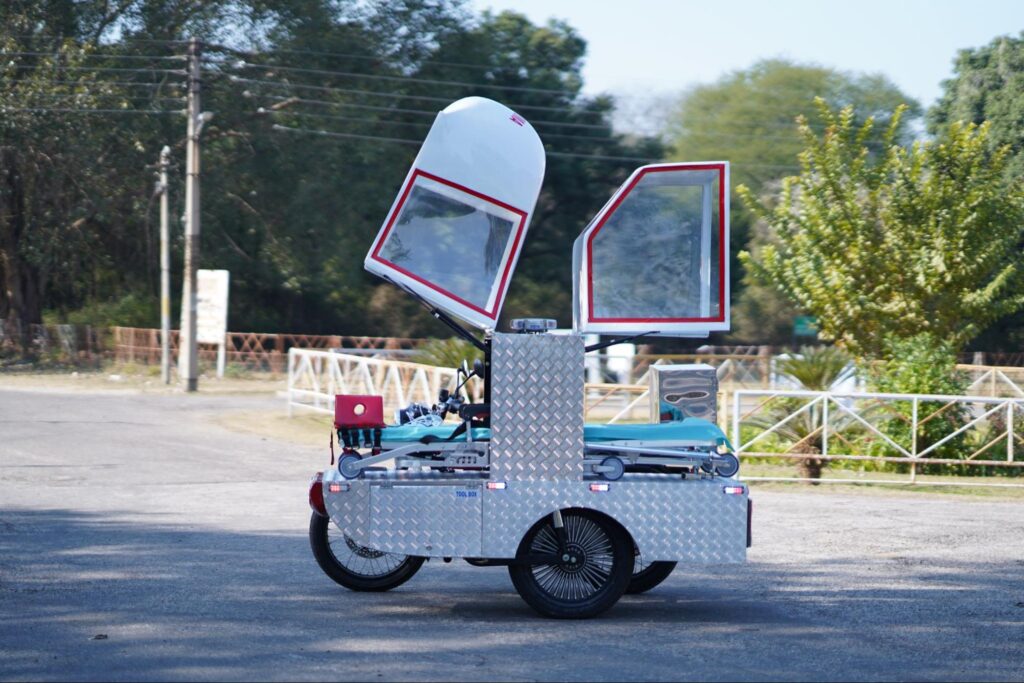
Sidecar units go a step further  spine board, patient stretcher, room to transport someone who can’t sit upright.

The goal was never to replace a hospital. Just keep the patient alive long enough to reach one.

The Role of Sidecars in First Responder Bikes

A common misconception is that a motorbike ambulance is simply a bike with a medical kit strapped to it. Sidecar configurations change the capability significantly.

A sidecar-equipped medical motorcycle can transport a lying patient  an entirely different level of utility. This matters for trauma cases, unconscious patients, or women in active labour who cannot remain seated.

Purpose-built ambulance sidecars are engineered for weight distribution and patient stability, with easy-access loading and compatibility across common motorcycle models. When built to proper standards and ARAI authorization, the result is not a makeshift solution  it is a genuine micro-ambulance designed for terrain where full-size vehicles cannot operate.

The sidecar approach gives rural health programs a deployable, affordable, and field-ready vehicle. That combination is difficult to achieve any other way.

Challenges in Deploying Bike Ambulances and How They Are Being Addressed

Bike ambulances in India face real operational challenges, and it is worth being direct about them.

Training remains an ongoing need. First responders must be equipped not just to ride, but to deliver initial medical care under pressure. State health programs and NGOs have been investing in community health worker training, and coverage is improving  but gaps remain in the most remote districts.

Infrastructure is another factor. Even a motorcycle cannot navigate every terrain condition. Some areas still need road connectivity improvements alongside better vehicle solutions, and the two investments work best in parallel.

Awareness at the community level also lags behind. Many residents in remote areas are unaware that bike ambulance services exist or how to access them. Last-mile communication is as important as last-mile transport.

None of these challenges invalidate the model. They shape how it should be deployed  with proper training frameworks, community integration, and ongoing support from local health systems. The core vehicle solution is sound.

The Future of First Responder Motorcycles and Where the Technology Is Heading

The motorcycle ambulance is not a static concept. The technology and programs around it are actively developing.

Electric bike ambulances are being explored in several programs  quieter, lower in maintenance, and better suited for hilly terrain where managing fuel supply is logistically complex. Solar charging infrastructure at village health centres is being developed alongside these units.

GPS tracking and telemedicine integration are being added to some deployments, allowing a riding responder to consult with a doctor remotely while in transit to the patient. This effectively extends specialist care into areas that would otherwise have none.

Drone-delivered medical supplies are also being piloted as a complement to the rural area bike ambulance model enabling blood, medication, or critical supplies to be dropped at a location before the responder even arrives.

The motorcycle ambulance is not a stopgap measure. It is a developing platform with considerable room to grow.

Why Inder Auto Industries Stands Apart in This Space

Deploying a motorcycle ambulance in India  whether for an NGO, a state health program, a CSR initiative, or an international development project  depends heavily on the quality of the vehicle and its attachment. A poorly engineered sidecar in remote field conditions is not just ineffective; it is a liability.

Inder Auto Industries has been manufacturing sidecar and vehicle attachment solutions since 1989. The company holds ARAI authorization from the Government of India and has exported its products internationally. Their ambulance sidecar for motorcycles and scooters is built for real-world Indian field conditions  engineered for weight distribution, patient stability, ease of loading, and compatibility with widely available motorcycle models.

This is not a large conglomerate producing medical vehicles as a side product. This is a focused manufacturer with over three decades of specialized experience in sidecar design, built around the specific demands of Indian roads and terrain. That depth of experience matters when the vehicle needs to perform reliably in conditions that would compromise lesser equipment.

For organizations serious about first responder bike deployment, that track record is worth more than any specification sheet.

Final Thought

A bike ambulance does not attract headlines the way a new hospital wing does. It is not a glamorous investment. But in a remote village, when someone needs emergency care and the nearest road is five kilometres of mud, a motorcycle ambulance arriving in time is the difference between life and death.

The solution exists. It is field-proven, increasingly sophisticated, and more accessible than ever. What it needs is broader deployment, sustained funding, and continued awareness.

For organizations looking to make a measurable impact on rural emergency healthcare access  or for procurement teams evaluating first responder vehicle solutions  visit Inder Auto Industries to learn more about what Inder Auto Industries offers and how their solutions can be deployed in the field.

FAQs

What is a Motorcycle Ambulance and How Is It Different from a Regular Ambulance? 

A motorcycle ambulance is a motorcycle fitted with a sidecar or medical attachment carrying emergency supplies and sometimes a patient stretcher. Unlike a standard ambulance van, it is designed for speed and access in terrain where four-wheeled vehicles cannot operate effectively.

How Does a Bike Ambulance Operate in Remote Areas of India?

A trained first responder rides the medical motorcycle to the emergency site, provides initial stabilization and care, then transports the patient to the nearest health facility. In sidecar configurations, patients can be transported lying down, which is critical for trauma or unconscious cases.

Which Indian States Have Led the Way in Motorbike Ambulance Deployment? 

States including Odisha, Assam, Jharkhand, Chhattisgarh, and several northeastern states have piloted or deployed bike ambulance programs, primarily for maternal health emergencies and accident response in remote tribal and hilly areas.

What Medical Equipment Does a Rural Area Bike Ambulance Carry? 

Standard equipment includes trauma kits, bandages, portable oxygen, a blood pressure monitor, IV fluids, anti-snake venom where relevant, and a communication device. Sidecar configurations may also include spine boards or patient stretchers.
Motorcycle Ambulance IndiaCategoriesMotorcycle Ambulance

How Motorcycle Ambulance Systems Are Closing the Rural Healthcare Gap

Rural Healthcare Is Not Just About Hospitals

People usually think of rural healthcare in terms of hospitals, doctors, maybe equipment. That’s the usual picture.

But that’s not really where things start going wrong.

It’s more about the delay, honestly.

In a lot of villages, help isn’t completely out of reach. It’s there… just not quick enough. Roads aren’t always great some are narrow, some are in bad shape, some barely connect properly. So even if an ambulance is somewhere nearby, getting it to the patient fast isn’t as simple as it sounds.

And that gap, the time between needing help and actually getting it that’s where a Motorcycle Ambulance starts to make a difference.

Understanding What a Motorcycle Ambulance Really Does

A motorcycle ambulance people also call it a bike ambulance or motorbike ambulance isn’t designed to replace the bigger ambulances.

It’s more about reaching the patient first, before anything else.

Why Reaching the Patient Is Still a Problem

Traditional ambulances are designed for proper roads and predictable routes. That works well in cities. Rural areas are a different story.

The roads can be too narrow for larger vehicles. Some paths are uneven, and in certain places, there isn’t a clear route at all. Add distance to that, and the delay becomes unavoidable.

This is why even with ambulance services in place, response time in rural regions often remains inconsistent.

And that’s exactly where smaller, more adaptable solutions like Motorcycle Ambulances India start to fill the gap.

How These Systems Actually Work in Real Situations

A Motorcycle Ambulance doesn’t operate alone. It works as part of a system.

When an emergency call comes in, the smaller unit can move immediately. It doesn’t wait for road clearance or wide access. It simply reaches the location faster.

Once there, basic support begins. It could be first aid, initial stabilization, or simply assessing the situation. Meanwhile, if needed, a larger ambulance is coordinated to meet at a reachable point.

So instead of one delayed response, the system becomes layered and more efficient.

The Difference It Makes on the Ground

The impact of a bike ambulance becomes clear when you look at response time.

Motorcycle Ambulance India


Even a short reduction in delay can improve outcomes. In emergency situations, those few minutes are often critical.

What also changes is coverage. Areas that were previously considered “difficult to access” are no longer completely cut off. A bike ambulance India model allows services to extend into those zones without waiting for perfect infrastructure.

It’s not a dramatic transformation overnight. But it’s a steady improvement and a practical one.

Why Design Is Not Something You Can Ignore

There’s a tendency to think any motorcycle can be converted into an ambulance. That’s not really true.

A poorly designed motorbike ambulance can be unstable, hard to control, or simply not usable in real conditions. Balance matters. Structure matters. Even the placement of equipment matters.

A proper Motorcycle Ambulance needs to feel stable on rough roads, carry its load without affecting handling, and remain reliable over time.

Where These Systems Are Being Used

The use of Medical Motorcycle systems is slowly expanding, especially in areas where traditional access is limited.

They are being used for emergency response in villages, for reaching accident locations faster, and even in certain outreach or relief efforts where mobility is restricted.

The role is always the same reach first, support early, and connect to the larger system.

It’s Not a Replacement And That’s Important

A motorcycle ambulance cannot replace a traditional ambulance. It doesn’t have the space or capability for that.

But it doesn’t need to.

Its strength lies in handling the part that larger vehicles struggle with getting to the patient quickly. Once that’s done, the rest of the system can take over.

Understanding this balance is important. It’s not about choosing one over the other. It’s about using both effectively.

Why Quality Still Matters More Than Speed

Speed alone isn’t enough.

If a bike ambulance isn’t reliable, it defeats the purpose. These vehicles are used in demanding conditions, and they need to hold up over time.

A well-built Motorcycle Ambulance should remain stable, durable, and consistent even with regular use on rough roads.

That’s why manufacturers like Inder Auto Industries put emphasis on long-term performance. Because in real-world use, reliability matters just as much as response time.

Closing Thought

The rural healthcare gap is not a simple problem. It won’t be solved by one solution alone.

But improving how quickly help reaches people is a strong step forward.

A Motorcycle Ambulance doesn’t fix everything. But it fixes something important and sometimes, that’s enough to make a real difference.

FAQs

What is a Motorcycle Ambulance used for?

A Motorcycle Ambulance is used for rapid response, especially in areas where larger ambulances cannot reach quickly.

How does a bike ambulance help in rural India?

A bike ambulance India system improves response time by navigating narrow roads and difficult terrain.

Is a motorbike ambulance safe to use?

Yes, when properly designed, a motorbike ambulance is stable and reliable for emergency response.

Why are Motorcycle Ambulances India important?

They help reduce delays in reaching patients, especially in remote and rural locations.


Motorcycle AmbulanceCategoriesMotorcycle Ambulance

When Every Minute Matters: Motorcycle Ambulances Saving Lives in Rural Areas

In rural areas, emergencies feel different. Not because they’re less serious. Actually, the opposite. The problem is distance… and roads.

Someone collapses in a village. A farm accident happens miles away from the nearest clinic. A snake bite at night. These things happen more often than people think. But getting medical help there quickly? That’s the real challenge.
Big ambulances struggle in these places. Narrow lanes, broken roads, muddy tracks after rain. Sometimes the vehicle simply can’t reach the patient fast enough.

This is exactly where a Motorcycle Ambulance starts to make real sense.

Across many parts of India, Motorcycle Ambulances are becoming a practical solution for emergency response in remote communities.

The Rural Emergency Problem Most People Ignore

Cities have hospitals every few kilometers. Rural areas don’t.
In many places, villages are still quite far from proper medical centers. Reaching them isn’t always easy either. Some roads are narrow, others are just dusty tracks running between fields. It’s common to see tractors, motorcycles, or even animals sharing the same path. And once the monsoon starts, those routes can quickly turn muddy, which makes driving slow and sometimes pretty difficult.
A traditional ambulance van is large. Heavy. Slow on bad roads.
So response time stretches longer and longer.
And in an emergency stroke, trauma, severe bleeding waiting even 20 minutes can be too long.
A motorbike ambulance can reach these places much faster.

What Is a Motorcycle Ambulance?

A Motorcycle Ambulance is a specially modified motorcycle designed for emergency medical response.
Usually, the motorcycle is fitted with a sidecar or medical trailer that carries emergency equipment. Some designs even include a stretcher for patient transport.

Motorcycle Ambulance


A well-equipped Medical Motorcycle may include:
First aid and trauma kits

Oxygen cylinder

Emergency lighting and siren

Medical storage compartments

Patient stretcher in a sidecar

It’s a simple concept. But when designed properly, it becomes an extremely effective rural emergency vehicle.

Why Motorcycle Ambulances Work So Well in Rural Areas

The real advantage here is simple mobility. A motorbike ambulance can slip through narrow village lanes where a full-size ambulance just won’t fit. It handles rough roads, dirt tracks, even those uneven farm paths that you see outside most villages. A big vehicle would slow down or sometimes turn back. A motorcycle keeps moving.

Motorcycle Ambulance in india

Because of that, the response time drops a lot. Instead of waiting for a large ambulance that might get stuck on the way, a Motorcycle Ambulance can reach the patient much quicker. Sometimes in just a few minutes.

And those early minutes matter more than people realize. When someone starts getting medical help right away stopping heavy bleeding, giving oxygen, even simple first aid it can completely change the outcome. In many cases, it gives the patient a real chance to make it to the hospital.

Faster Response Means More Lives Saved

When something serious happens, people start watching the clock. A few minutes suddenly feel much longer than they normally would.
In a lot of rural places, help doesn’t arrive immediately. The ambulance might be coming from a nearby town, and the drive to the village isn’t always simple. Some roads are narrow lanes between houses, while others are rough or not well maintained. If the weather gets bad, things can slow down even more. By the time the ambulance finally reaches the patient, the situation may already be more serious than it was at the beginning.
Because of situations like this, Motorcycle Ambulances have started getting more attention in rural emergency services.
They’re smaller and easier to maneuver, which helps a lot on tight village paths and uneven roads. In many cases, a responder can reach the patient earlier and start basic care there, while plans are made to move the patient to the nearest hospital.
And in an emergency, those first few minutes can make a bigger difference than most people think.

A Practical and Affordable Emergency Solution

Healthcare budgets in rural regions are often limited. Buying and maintaining a fleet of large ambulances isn’t always realistic.
A motorbike ambulance offers a much more affordable alternative.
Motorcycles consume less fuel. Maintenance costs are lower. And they can cover large rural areas efficiently.
This makes them ideal for:
Rural hospitals

Community health programs

NGOs and emergency services

Remote clinics

Instead of waiting for large-scale infrastructure upgrades, communities can deploy Medical Motorcycle units right away.

Designed for Tough Rural Conditions

Rural environments can be hard on vehicles. Dust, heat, rough roads not every emergency vehicle handles that well.
A properly built Motorcycle Ambulance is designed to handle these conditions. Strong sidecar frames, stable suspension systems, and durable materials help the vehicle perform reliably day after day.

Motorcycle Ambulance design

Quality construction matters a lot here. Emergency vehicles must work when people depend on them most.
Manufacturers who specialize in motorcycle sidecars and emergency attachments play an important role in making these vehicles reliable for rural service.

A Growing Solution Across India

More regions are starting to recognize the value of Motorcycle Ambulances.
These vehicles are being used for first response in remote areas where large ambulances cannot easily travel. They act as the fastest way to bring medical help directly to the patient.
The concept is simple: reach the patient fast, stabilize the situation, and then arrange full hospital transport if needed.
For rural healthcare systems, this approach is proving to be extremely effective.

The Future of Rural Emergency Care

Healthcare in rural areas is slowly shifting. Not overnight, but things are changing. People are beginning to realize that smaller, practical solutions sometimes work better than big complicated systems especially in places where large ambulances struggle to even reach.
A Motorcycle Ambulance isn’t meant to take the place of a regular ambulance.That isn’t really what it’s meant for. Think of it more as the vehicle that can reach the patient first, especially in places that are far away or difficult for bigger ambulances to access.

Motorcycle Ambulance care

In many villages, farms, and remote settlements, quick medical help hasn’t always been easy to get. For a long time, people in these areas had to wait while help traveled from far away. A solution that could actually reach them during an emergency was something many communities needed for years.
And honestly, speed matters a lot in those moments. Getting help there even a little faster can change the whole situation.
For organizations or health services trying to improve emergency response in rural areas, Inder Auto Industries builds motorcycle ambulance systems designed exactly for these kinds of conditions, places where a traditional ambulance might struggle to go.

FAQs About Motorcycle Ambulances

What is a Motorcycle Ambulance?

A Motorcycle Ambulance is basically a motorcycle that has been set up to help during medical emergencies. It isn’t just a normal bike anymore. Usually there’s a sidecar or a small trailer attached, along with space for basic medical supplies.
The whole idea is pretty simple. In places where a large ambulance can’t easily go like narrow village lanes or rough rural roads a motorcycle can still get through and reach the patient much faster. That quick access can be really important when someone needs help right away.

Why are Motorcycle Ambulances useful in rural areas?

In a lot of rural areas, roads aren’t always great. Some are narrow village lanes, others are rough or uneven, and a few are barely paved at all. A large ambulance can slow down a lot in those situations. A Motorcycle Ambulance handles those roads much better, so responders can often reach the patient faster.

What equipment does a Medical Motorcycle carry?

A Medical Motorcycle usually carries the basic things needed to help someone during an emergency. First aid supplies, oxygen, trauma kits, and emergency lights are common. There’s usually some storage space for medical gear too. In some designs, the sidecar is set up to carry a stretcher so a patient can be transported if needed.

Are motorbike ambulances cheaper than traditional ambulances?

In most situations, yes, they usually are. Running a motorbike ambulance doesn’t cost nearly as much as operating a large ambulance van. Motorcycles burn far less fuel, and the upkeep tends to be simpler too. For rural clinics, small health programs, or community groups, that lower cost can make a big difference when they’re trying to provide emergency support without a huge budget.

Where are Motorcycle Ambulances commonly used?

You’ll usually find Motorcycle Ambulances working in places that are a bit harder to reach. Think small villages, farming areas, or locations that sit far from bigger towns. In those spots, roads can be narrow or uneven, and a large ambulance doesn’t always move easily.

A motorcycle handles those conditions a lot better. It can weave through tight lanes or rough patches of road and get to the patient sooner. And when someone is waiting for medical help, even a small time difference can matter quite a bit.


Motorcycle AmbulancesCategoriesBusiness

Top Benefits of Using Motorcycle Ambulances

In the ever-evolving landscape of emergency medical services, motorcycle ambulances are emerging as a game-changing solution. Combining speed, agility, and accessibility, these two-wheeled lifesavers are proving to be invaluable, especially in urban areas and congested environments. This blog explores the top benefits of using motorcycle ambulance, highlighting why they are becoming an essential component of modern emergency response systems.

1. Rapid Response Times

One of the most significant advantages of motorcycle ambulances is their ability to navigate through traffic quickly. In densely populated urban areas where traffic congestion can delay traditional ambulance services, motorcycle ambulances can weave through vehicles, reaching the scene much faster. This rapid response capability is crucial in medical emergencies where every second counts, significantly improving the chances of patient survival and recovery.

2. Access to Hard-to-Reach Areas

Motorcycle ambulances can easily access locations that might be challenging for larger vehicles. Narrow streets, alleys, pedestrian zones, and off-road areas pose no obstacle for these agile machines. This makes motorcycle ambulances particularly effective in rural areas, slums, and during large public events where crowd density can impede the movement of conventional ambulances.

3. Cost-Effective Solution

Compared to traditional ambulances, motorcycle ambulances are much more cost-effective. They require less fuel, have lower maintenance costs, and are generally cheaper to purchase. This cost efficiency allows emergency services to deploy more units within the same budget, ensuring broader coverage and faster response times across different regions.

4. Enhanced Patient Outcomes

The ability to provide immediate medical intervention is a critical benefit of motorcycle ambulances. Equipped with essential medical supplies and tools, these ambulances enable paramedics to start treatment right at the scene. Early intervention can stabilize patients, manage pain, and prepare them for transport to a hospital, leading to better overall patient outcomes.

5. Reduced Environmental Impact

Motorcycle ambulances are more environmentally friendly than their larger counterparts. They emit fewer pollutants and consume less fuel, contributing to lower carbon emissions. This environmental benefit is particularly important in cities struggling with air quality issues, making motorcycle ambulances a sustainable choice for emergency medical services.

6. Versatility and Flexibility

Motorcycle ambulances are incredibly versatile and can be adapted for various emergency scenarios. They can be outfitted with different types of medical equipment based on the needs of the service area. Whether it’s a cardiac emergency, trauma incident, or general medical assistance, motorcycle ambulances can be tailored to meet specific requirements, providing a flexible solution for emergency responders.

7. Increased Coverage and Availability

Deploying motorcycle ambulance increases the overall coverage and availability of emergency services. With their lower operational costs, more units can be stationed across a city or region, ensuring that help is never far away. This increased availability enhances the overall efficiency of emergency medical services, ensuring quicker assistance to a larger number of people.

8. Positive Public Perception

The innovative use of motorcycle ambulances often garners positive public perception. Communities appreciate the prompt and efficient service, leading to increased trust and cooperation with emergency medical services. This positive relationship can be beneficial in emergency situations, as it encourages the public to call for help without hesitation, knowing that assistance will arrive quickly.

Conclusion

Motorcycle ambulances represent a revolutionary advancement in emergency medical services. Their ability to navigate through traffic swiftly, access hard-to-reach areas, and provide immediate medical care significantly enhances emergency response times and patient outcomes. Additionally, their cost-effectiveness, environmental benefits, and versatility make them an ideal choice for modern emergency medical systems.

As urban populations continue to grow and traffic congestion becomes an increasing challenge, the adoption of motorcycle ambulances is likely to rise. By integrating these agile and efficient vehicles into their fleets, emergency services can ensure that they are better equipped to save lives and improve public health outcomes.

For more information on motorcycle ambulances and to explore our range of products, visit the Inder Auto Industries.